

Instrumental performance - Jazz Instruments
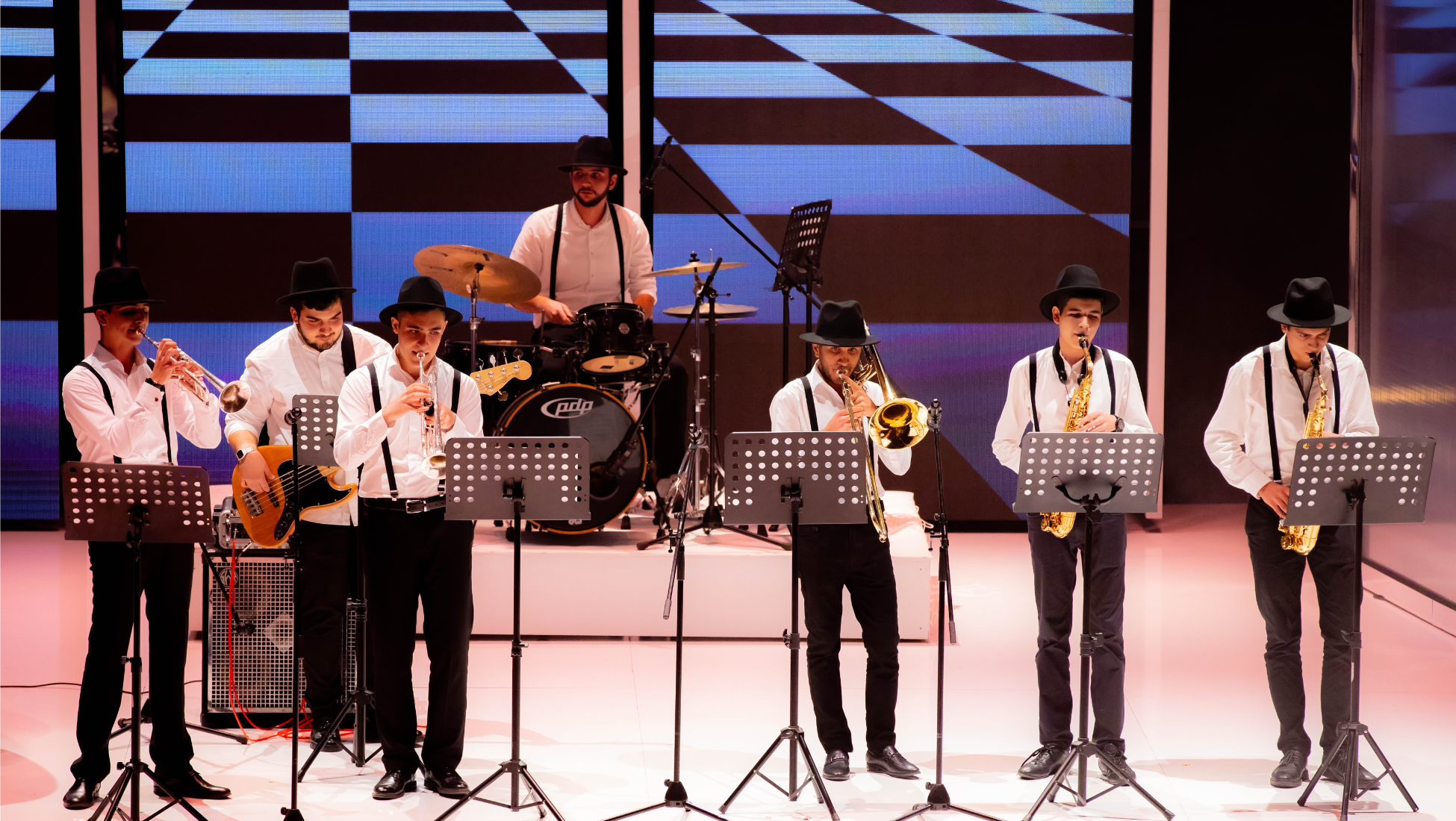
Instrumental performance - Jazz Instruments
ELIGIBILITY
DEADLINES
Online application submission via the dimord.am website:
-
First stage: From April 15 until May 10, at 18:00 (for applicants graduating from general, preliminary, or middle vocational educational institutions of the Republic of Armenia in the given academic year, as well as graduates of previous years).
-
Second stage: From June 26 until July 1, at 17:00 (for foreign nationals, citizens of the Republic of Armenia who graduated from educational institutions of foreign states in the given academic year, and applicants demobilized from the summer military draft of that year or demobilizing before July 31).
Document Submission
For all applicants: After May 17, according to the schedule specified in the email sent by the Executive Secretary of the YSC Admissions Committee.
Attention: Please fill in your email address and phone numbers accurately in the application, as all information related to the admissions process will be communicated through them.
Examination Schedule
For all applicants: July 2 to 8.
Admissions Competition Results Summary
For all applicants: July 18.
Academic Year
- First semester: September 1 to January 25
- Second semester: February 9 to June 28
Note: Deadlines are subject to change in accordance with the decree of the Minister of Education, Science, Culture and Sports of the Republic of Armenia.
ADMISSION PROCESS
1. Preparation for Entrance Examinations
To be admitted to the Bachelor's degree program in "Musical Art (Composition)," applicants must meet or exceed the competitive admission threshold.
2. Document Submission
-
Original and 2 copies of an identity document (passport, birth certificate, or ID card).
-
Original and 2 copies of the Social Services Card (Public Services Number).
-
6 photos (3x4 cm size).
-
Original and 2 copies of the educational graduation certificate (high school diploma/attestat or college diploma).
-
Original payment receipt for the 3,000 AMD fee deposited into account number 900018002072. (Reminder: Applicants eligible for privileges defined under clauses 78–81 of the Admission Regulations are exempt from this fee).
-
Military record booklet (for demobilized applicants) or draft registration certificate issued by the local military commissariat.
-
Original and 1 copy of award diplomas from international and national competitions (if applicable).
-
If applicable, original documents verifying eligibility for admission privileges under clauses 73 and 78–81 of the Admission Regulations.
-
For applicants from families registered in the Family Poverty Assessment System, the corresponding certificate indicating the "Paros" score.
-
A list of submitted compositions including titles and genres. Please provide this program in printed form (Font: Sylfaen, Size: 14), with the applicant's full name at the bottom. Sheet music and/or audio recordings must be presented on the examination day.
3. Entrance Examinations
JAZZ PIANO
MAJOR / SPECIALTY (Performance Program)
-
Two jazz standards of contrasting character
-
One work by an Armenian composer
-
Sight-reading
MUSIC THEORY KNOWLEDGE (Written)
-
a) Solfège (Ear Training / Dictation): The applicant must transcribe an 8-measure two-part (polyphonic) dictation containing chromatic tones and tonicizations (deviations). The key, time signature, and initial notes of both the melody and the bass are specified in advance.Duration: 30 minutes, played once every 2–3 minutes.
-
b) Harmony: The applicant must harmonize a melody of 10–12 measures in the form of an extended period, containing possible tonicizations and modulations into first-degree related keys, without the use of non-chord tones.Duration: 2 hours.
JAZZ SAXOPHONE
MAJOR / SPECIALTY (Performance Program)
-
One étude
-
Two jazz/pop standards of contrasting character
-
Improvisation on a given theme
-
Sight-reading
MUSIC THEORY KNOWLEDGE (Written)
-
a) Solfège (Ear Training / Dictation): The applicant must transcribe an 8-measure monophonic dictation containing chromatic tones. The key, time signature, and initial note of the dictation are specified in advance.Duration: 30 minutes, played once every 2–3 minutes.
-
b) Harmony: The applicant must harmonize a melody of 10–12 measures in the form of an extended period, containing possible tonicizations into first-degree related keys, without the use of non-chord tones.Duration: 2 hours.
JAZZ GUITAR
MAJOR / SPECIALTY (Performance Program)
-
Two jazz standards and one blues
-
Scales in all keys
-
Figured bass / chord chart reading (harmonic realization from chord symbols)
-
Sight-reading
MUSIC THEORY KNOWLEDGE (Written)
-
a) Solfège (Ear Training / Dictation): The applicant must transcribe an 8-measure monophonic dictation containing chromatic tones. The key, time signature, and initial note of the dictation are specified in advance.Duration: 30 minutes, played once every 2–3 minutes.
-
b) Harmony: The applicant must harmonize a melody of 10–12 measures in the form of an extended period, containing possible tonicizations into first-degree related keys, without the use of non-chord tones.Duration: 2 hours.
PROHIBITED VOICE-LEADING AND HARMONIZATION ERRORS (According to Standard Textbook Definitions):
-
Incorrect determination of the melody's key
-
Incorrect structural division (caesura, cadence, half-cadence, extension)
-
Incorrect functional resolution
-
Metric shift of a chord (harmonic syncopation / repeating a harmony from a weak beat to a strong beat)
-
Incorrect chord spacing / voicing
-
Parallel and direct (hidden) fifths and octaves
-
Melodic leaps by augmented intervals
-
Cross-relations (false relations)
-
Incorrect chord progression
-
Incorrect resolution of seventh chords
-
Overlooking sequences, deviations (tonicizations), and modulations
-
Musical notation spelling / orthographic errors
-
Accidental/key signature errors, etc.
GRADING SCALE
- 18–20 points: Excellent
- 13–17 points: Good
- 8–12 points: Satisfactory
- 7 points and below: Unsatisfactory

