

Գործիքային կատարողականություն - Ժողովրդական գործիքներ
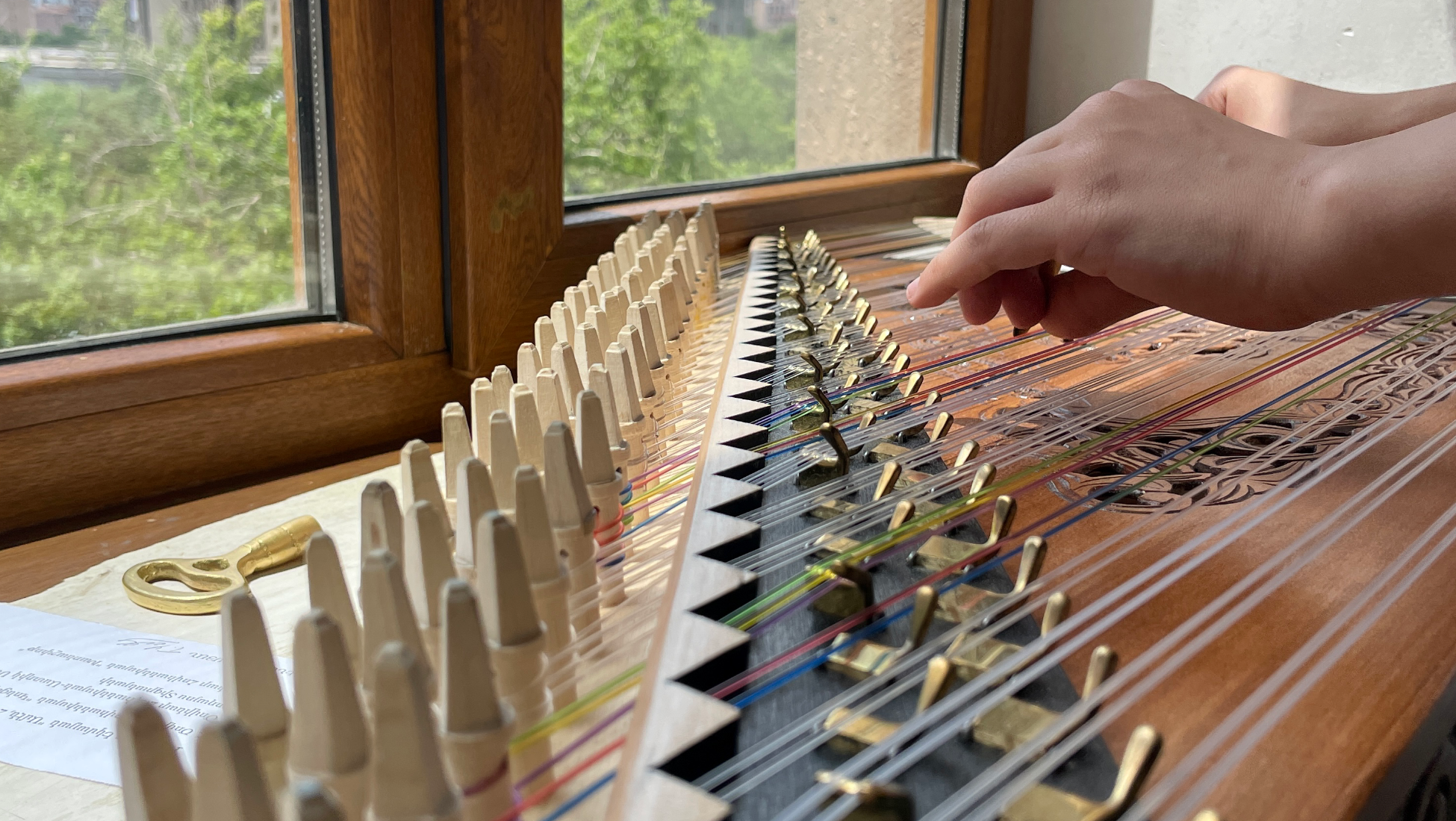
Instrumental performance - Folk Instruments
ELIGIBILITY
Individuals with secondary or vocational education may apply to the educational program in Instrumental Performance: DUDUK, SHVI, BLUL, QANUN, TAR, KAMANCHA, OUD, SANTUR.
Admissions are conducted on a competitive basis through entrance examinations. To participate in the entrance examinations, applicants must register within the deadlines established by the regulations and submit the required documents.
Attention: A certificate of music education is not required for admission to YSC (Yerevan State Conservatory).
DEADLINES
Online application submission via the dimord.am website:
-
First stage: From April 15 until May 10, at 18:00 (for applicants graduating from general, preliminary, or middle vocational educational institutions of the Republic of Armenia in the given academic year, as well as graduates of previous years).
-
Second stage: From June 26 until July 1, at 17:00 (for foreign nationals, citizens of the Republic of Armenia who graduated from educational institutions of foreign states in the given academic year, and applicants demobilized from the summer military draft of that year or demobilizing before July 31).
Document Submission
For all applicants: After May 17, according to the schedule specified in the email sent by the Executive Secretary of the YSC Admissions Committee.
Attention: Please fill in your email address and phone numbers accurately in the application, as all information related to the admissions process will be communicated through them.
Examination Schedule
For all applicants: July 2 to 8.
Admissions Competition Results Summary
For all applicants: July 18.
Academic Year
- First semester: September 1 to January 25
- Second semester: February 9 to June 28
Note: Deadlines are subject to change in accordance with the decree of the Minister of Education, Science, Culture and Sports of the Republic of Armenia.
ADMISSION PROCESS
1. Preparation for Entrance Examinations
To be admitted to the undergraduate program in Instrumental Performance: DUDUK, SHVI, BLUL, QANUN, TAR, KAMANCHA, OUD, SANTUR, applicants must pass the competitive threshold of the entrance examination.
If you wish to improve your skills ahead of the admissions process, you may participate in the Preparatory Courses offered by the Conservatory, which launch in the first semester of each academic year. Through these preparatory courses, the YSC applicant acquires the relevant knowledge required to surpass the competitive threshold of the entrance examinations.
2. Submission of Documents
Applicants must fill out the admission application on the Assessment and Testing Center (ATC / ԳԹԿ) website: dimord.am. You can familiarize yourself with the application procedure via the ATC instructional video.
After submitting the online application, the following documents must be submitted in person within the established deadlines to the Executive Secretary of the YSC Entrance Examinations:
- Original and 2 copies of an identification document (passport, birth certificate, or ID card).
- Original and 2 copies of the Social Security Card (Public Services Number).
- 6 photos (3x4 cm size).
- Original and 2 copies of the graduation certificate (school certificate/attestat or diploma).
- Original receipt of the 3,000 AMD payment made to account number 900018002072. (Note: Applicants eligible for fee privileges under points 78–81 of the Admission Regulations are exempt from this payment).
- Military booklet (for demobilized applicants) or military registration certificate issued by the regional military commissariat.
- Originals and 1 copy of diplomas certifying laureate status in international or national competitions.
- If applicable, original documents confirming the right to benefit from privileges defined by points 73 and 78–81 of the Admission Regulations.
- For applicants from families registered in the Family Poverty Assessment System, the relevant document indicating the "Paros" score.
- The titles and genres of the submitted musical pieces. Sheet music and/or recordings are to be submitted on the day of the exam. Please present the repertoire in printed format (Font: Sylfaen, Font size: 14), indicating the applicant's full name at the end.
Attention: In the absence of a passport or other identity document, the applicant must present a temporary identity document issued by their regional or capital police department.
3. ENTRANCE EXAMINATIONS
The entrance examinations for Instrumental Performance: DUDUK, SHVI, BLUL, QANUN, TAR, KAMANCHA, OUD, SANTUR comprise:
- Specialty (Repertoire Performance)
- Music Theory Knowledge (Written)
SPECIALTY (Repertoire Performance)
The applicant must perform a program lasting up to 20 minutes from memory, which must include:
- One large-scale work (concerto, sonata, rhapsody, fantasy).
- A medieval tagh or sacred piece without accompaniment.
- A suite of folk dance melodies (lyrical: slow tempo; dance: fast tempo), accompanied by traditional instrument(s).
A professional interview will also be held with the applicant regarding the performed program (covering composer, period, musical movement/style, piece, and key).
MUSIC THEORY KNOWLEDGE (Written)
The examination consists of two components completed during a single sitting at the examination center, administered as two written tasks:
a) Solfège
The applicant must write a single-voice (monophonic) dictation consisting of 8 measures, featuring chromatic tones. The key, meter, and starting pitch of the dictation will be announced in advance.
Execution time: 30 minutes, played once every 2–3 minutes.
b) Harmony
The applicant must harmonize a melody structured as a period of 10–12 measures, containing potential deviations to first-degree related keys, without the use of non-chord tones.
Execution time: 2 hours.
IMPERMISSIBLE HARMONIZATION ERRORS (According to Textbook Guidelines):
- Incorrect identification of melodic key
- Incorrect structural division (caesura, cadence, half-cadence, extension)
- Functional error in harmonic resolution
- Shifting a chord (harmonic function) from a weak beat to a strong beat
- Incorrect chord voicing/spacing
- Parallel or hidden fifths and octaves
- Melodic intervals of augmented steps
- Contradictions / voice-leading conflicts
- Incorrect progression/succession of chords
- Incorrect resolution of seventh chords
- Disregarding sequences, deviations, or modulations
- Orthographical notation errors
- Accidentals/key signature errors, etc.
Grading Scale
Examinations are evaluated on a 20-point scale:
- 18–20 points: Excellent (գերազանց)
- 13–17 points: Good (լավ)
- 8–12 points: Satisfactory / Passing (բավարար)
- 7 points and below: Unsatisfactory / Failing (անբավարար)

